General Semantics
What is general semantics and why is it important for a stable, sane society?
General Semantics: A Path to Sustainable Society and Collective Sanity
In an era of information abundance and global challenges, humanity faces a paradox: the more opportunities we have for communication, the more often we fail to understand each other. Political discussions turn into verbal battles, scientific facts are challenged by ideological beliefs, and social conflicts flare up due to differences in interpreting the same events. In this context, the teaching developed in the 1920s-1930s by Polish-American scientist and engineer Alfred Korzybski — general semantics — becomes particularly relevant.
What is General Semantics?
General semantics is not simply a theory about the meaning of words. It is a practical interdisciplinary system aimed at making us more conscious users of our own minds. It studies how people perceive the world, how they create their internal “maps” of reality from this perception, and how language and the hidden assumptions embedded within it shape our reactions, behavior, and ultimately, our destiny.
Korzybski’s fundamental principle, “the map is not the territory,” is the cornerstone of the entire system. Any model of the world that we create in our consciousness — whether through words, symbols, or beliefs — is merely an abstract, simplified, and always incomplete reflection of reality. A map is useful if its structure corresponds to the structure of the territory, but it will never be the territory itself in all its fullness. To confuse one with the other means opening the door to delusions, conflicts, and inadequate reactions.
The Roots of Modern Problems: Aristotle and Language Structure
Korzybski argued that many of our cognitive distortions and communication failures are rooted in the very structure of Indo-European languages, which implicitly follows Aristotelian logic. This logic, useful in certain contexts, imposes several harmful thinking habits upon us:
-
The Law of Identity (“A is A”): This formula forces us to perceive the world as static and unchanging. We say “this apple,” implying that the apple today is the same as it was yesterday, and that it is completely defined by this label. In reality, however, an “apple” is a continuous process, constantly changing at the microscopic level.
-
Elementalism: Language forces us to artificially separate what is inseparable in reality. We speak of “mind” and “feelings,” “body” and “soul,” “space” and “time” as separate entities, although in reality these are holistic, interconnected processes (
psycho-somatic,space-time). -
Two-valued Orientation: Aristotelian logic pushes us toward “either-or” thinking: true or false, good or bad, friend or enemy. This ignores the infinite number of gradations and variations that exist in the real world.
When “Nation,” “Freedom,” or “Justice” become not tools of thinking, but objects of worship, rational dialogue becomes impossible. People begin to fight not with real problems, but with phantoms of their own language.
Consciousness of Abstracting and Semantic Correctives
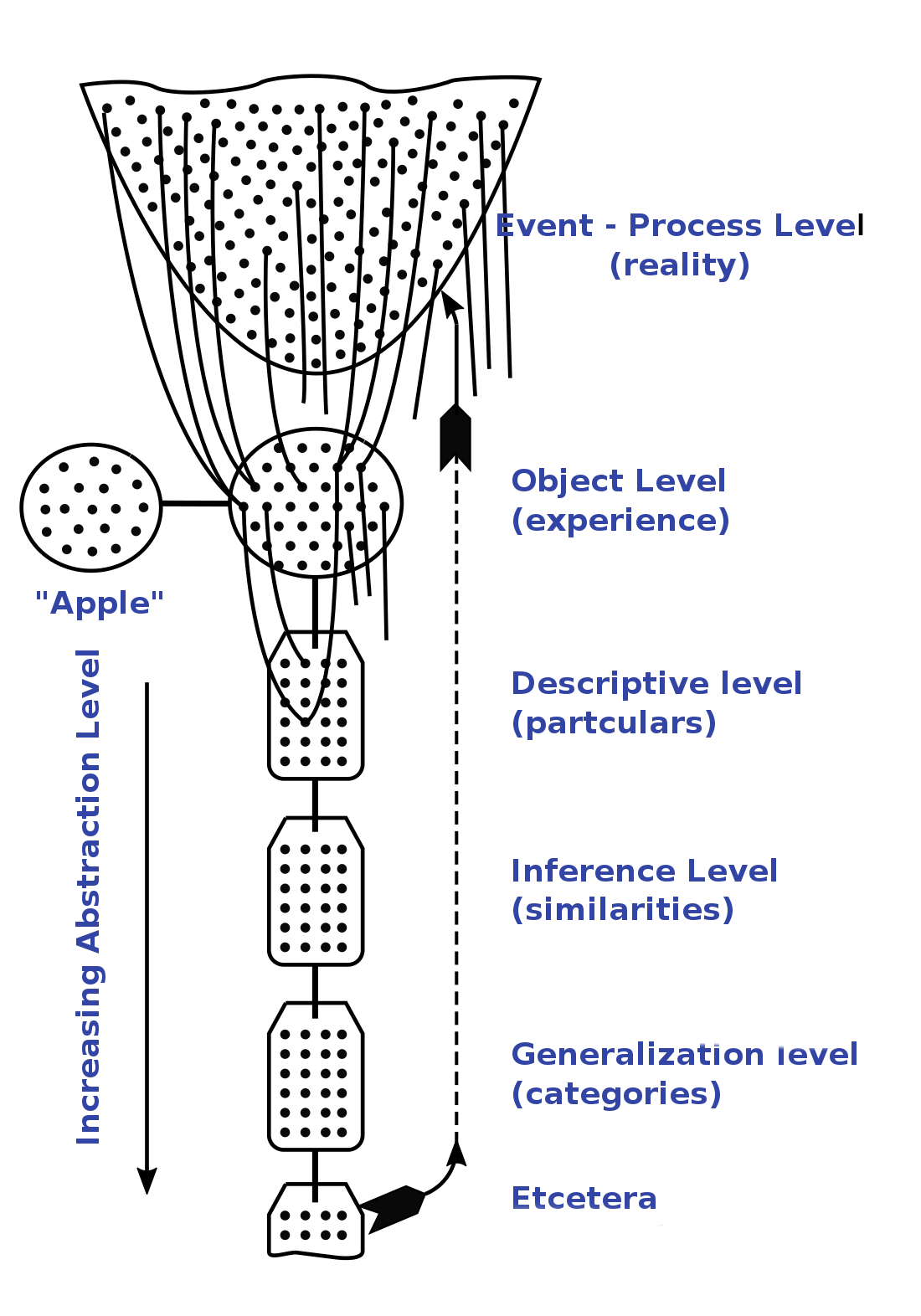
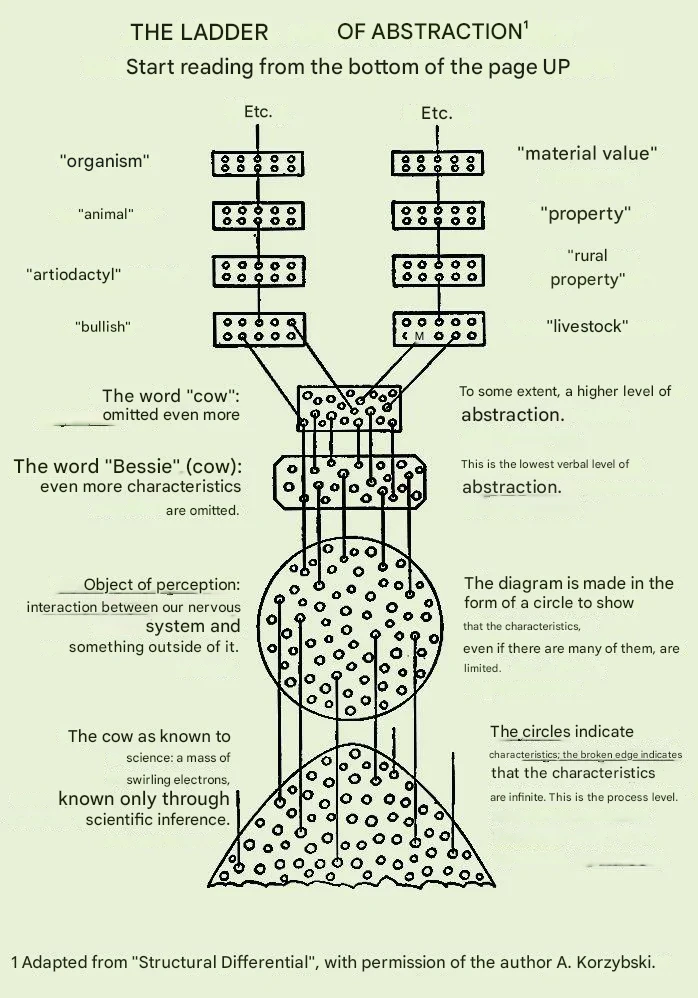
Korzybski’s central idea is the development of consciousness of abstracting. This is the ability to understand at every moment what level of generalization we are operating on and how much our “map” differs from the “territory.” To turn this idea into a practical skill, he developed a set of mental tools known as Semantic Devices. These are not merely symbols, but reminders that help train the nervous system to react to the world more adequately.
The image below explains the meaning of abstracting using the example of a cow. The higher the level of abstraction, the more simplified, incomplete, and generalized the description of the object becomes.
Key Semantic Correctives:
-
Indexes: To combat generalizations, Korzybski proposed mentally or in writing adding indexes to words.
Politician₁is notPolitician₂;Problem_Ais notProblem_B. This simple technique destroys false identity and forces us to consider each object or person as a unique phenomenon.Muslim₁(your neighbor, a doctor) is notMuslim₂(a terrorist from the news). -
Dating: To account for the factor of time and process, dates are added to indexes.
Anna₂₀₁₅(student) is notAnna₂₀₂₅(experienced professional). You yourself are not the same person you were a year ago (You_August_2024is notYou_August_2025). This is a reminder that the world and the people in it are in constant change. -
Etc.: The most important corrective. It serves as a constant reminder that any description, statement, or definition is incomplete. When we say: “The apple is red, round, and sweet,” we should mentally add “etc.” to remember the millions of other characteristics (its chemical composition, atomic structure, history, origin) that we have omitted. This develops intellectual humility and protects against categoricalness.
-
Quotes: Korzybski recommended putting quotation marks around words with high levels of abstraction or those used metaphorically. When a politician speaks of “justice” or “freedom,” we should mentally enclose these words in quotes —
"justice","freedom". This is a signal to our nervous system: “Attention, this word does not denote a concrete object. Its meaning may differ greatly for different people. Clarification is required.” -
Hyphens: Used for the visual overcoming of language elementalism. Instead of speaking of mind and body as different things, we should strive to think in terms of
psycho-somaticunity. Instead of space and time — about thespace-timecontinuum. The hyphen helps us structurally connect in our minds what is inseparable in reality.
The Path to Sustainable Society
1. Overcoming Elementalism through Systems Thinking
Traditional thinking divides holistic processes into parts: economy versus ecology, individual versus society. General semantics offers a non-elementalistic approach, reinforced by the hyphen, which views humans and the world as unified systems. Climate change, social inequality, technological challenges — these are socio-ecological-economic problems requiring systems thinking.
2. Culture of Dialogue Instead of Culture of Conflict
The awareness that each person’s map is unique and incomplete (the etc. principle) naturally leads to tolerance. Instead of imposing their “map,” people begin to compare them to enrich their common understanding of the “territory.” Differences in language and culture (for example, culture_A and culture_B) cease to be a threat and become an opportunity for mutual learning.
3. Rational Decision-Making and Immunity to Manipulation
A society where people are accustomed to indexing, dating, and putting quotes is less susceptible to manipulation. Citizens learn to ask the right questions: “Which specific politician_X are we talking about?”, “What exactly do you mean by 'national interests'?”, “On what time_period facts is this statement based?” This creates natural immunity against demagogy, fake news, and ideological extremes.
Practical Application in the 21st Century
-
In Education: Including general semantics principles helps prepare people capable of critical thinking. Students learn to distinguish levels of abstraction (fact, description, inference, theory), understand the limitations of models, and value uncertainty.
-
In Psychotherapy: General semantics methods underlie some areas of cognitive-behavioral therapy. By helping a person realize that their destructive reactions are caused not by the event itself (the “territory”), but by their inadequate interpretation (the “map”), significant therapeutic success can be achieved.
-
In Business and Management: Leaders using general semantics avoid generalizations (“all employees are lazy”) and make decisions based on specific data (
employee_Ainproject_BduringJuly_2025). This improves team communication and increases efficiency.
Conclusion: From Chaos to Harmony
General semantics does not offer ready-made answers. It offers something more valuable — a method of consciousness training that allows us to see the complexity of the world without becoming its victim. This is a path from the chaos of automatic reactions and verbal battles to the harmony of conscious interaction.
A sustainable society is not a society without conflicts, but a society possessing tools for their constructive resolution. This is a society in which people understand the limitations of their “maps” and are ready to correct them in light of new experience.
In an era when technologies multiply both our wisdom and our foolishness, the development of individual and collective sanity becomes the main condition for humanity’s survival and prosperity. General semantics, created almost a hundred years ago, is more relevant today than ever, offering us a clear path to a more reasonable future.
Related Topics
What is the brain and how do you use it?
About the processes that occur in the brain during thinking and learning, how our actions influence its development, how to control it, etc.
Accuracy of knowledge
Why do we often overestimate the depth of our knowledge and other aspects of our cognitive abilities?
Rationality
About stereotypes regarding rational individuals and what rationality truly entails.